We use essential cookies to run the website and, with your consent, analytics cookies from Google Analytics and Mixpanel. See our Privacy Policy and T&C.
Define extraction, storage, and update behaviour in schemas written by developers or agents. xmemory executes that specification through MCP, CLI, APIs, and integrations. Test and evolve your memory logic alongside your workflow code.
Control without the maintenance burden
Your schemas are the programming language for memory. Developers and agents define the rules, test their behaviour, and evolve them with the application. xmemory runs the extraction and storage pipeline according to that specification.
01
Schema defines the boundary
Choose which objects, fields, and relations can be stored. Their descriptions do more than supply product terminology: they fine-tune detection, disambiguation, classification, relations, normalization, and grounded derivation of schema-valid facts.
02
Structured and natural-language APIs
Write from messy context, explicit fields, or both. Scope reads and writes when your product knows the shape, while keeping flexible memory for everything less structured.
03
Freshness and conflict policy
Configure what counts as non-conflicting state, how facts should update, and when memories expire with TTL, so stale or contradictory memory does not become manual maintenance.
04
Import, export, and leave cleanly
Bring existing memory into xmemory, inspect what is stored, and export it when needed. Your memory stays a product asset, not a vendor trap.
Focused memory starts with schema
xmemory is a memory engine for saving and retrieving the facts that matter to your workflow. We do not believe useful memory means saving everything. We believe memory should be focused on your product, vertical, and agent task.
Not a transcript dump
Agents see too much context to remember all of it. xmemory is for the durable facts your product needs later, not every intermediate message.
Schema defines focus
Schema is a programming language for memory. It tells the engine which objects, facts, and relationships matter for your workflow.
Vertical by design
Support, sales, coding, research, and operations need different memory. Schema makes that domain model explicit instead of hidden in prompts.
The memory harness xmemory covers
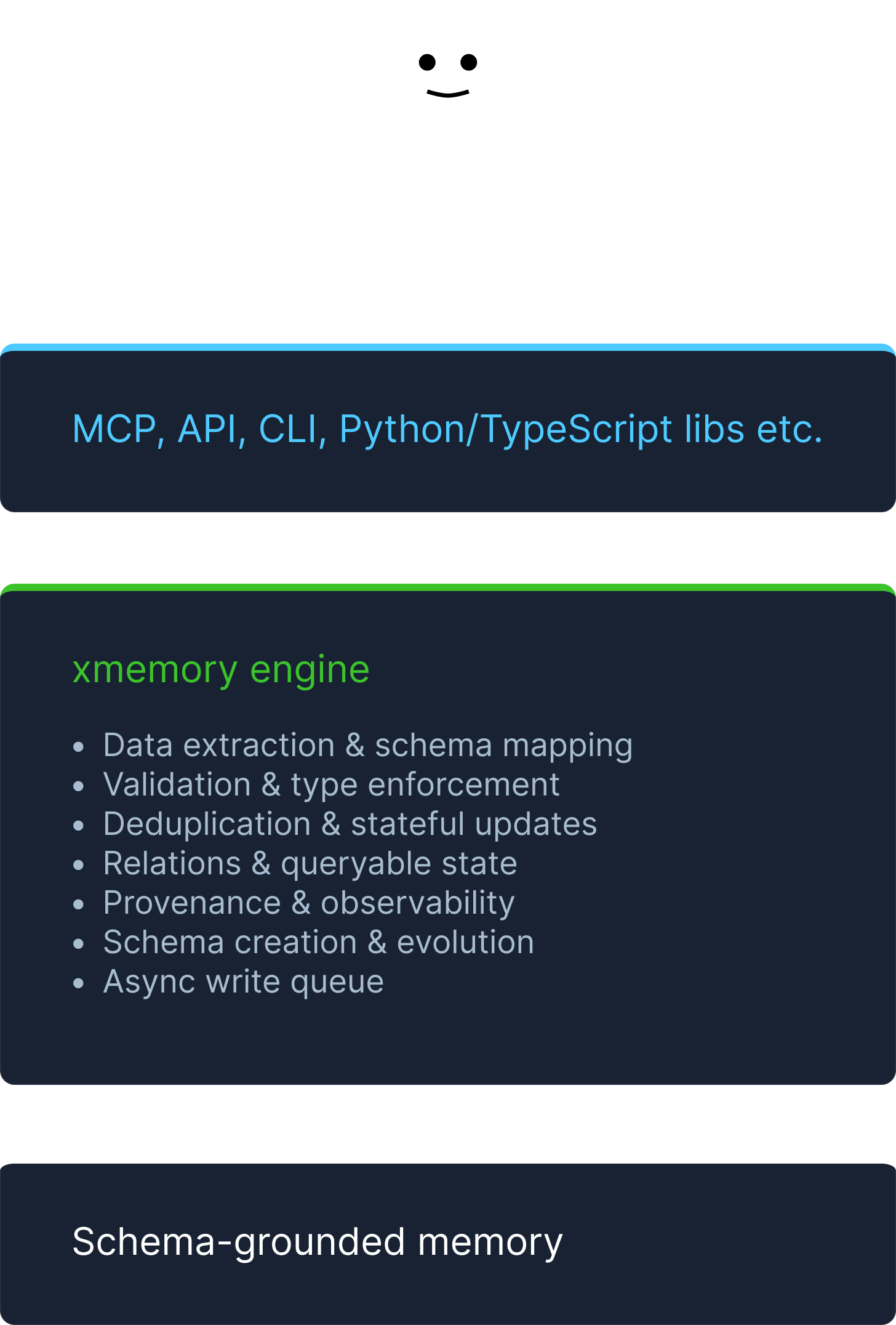
xmemory executes the memory specification you maintain. The engine applies your extraction instructions, maps facts to your schema, validates records, and manages memory operations while your product logic stays explicit and testable.
01
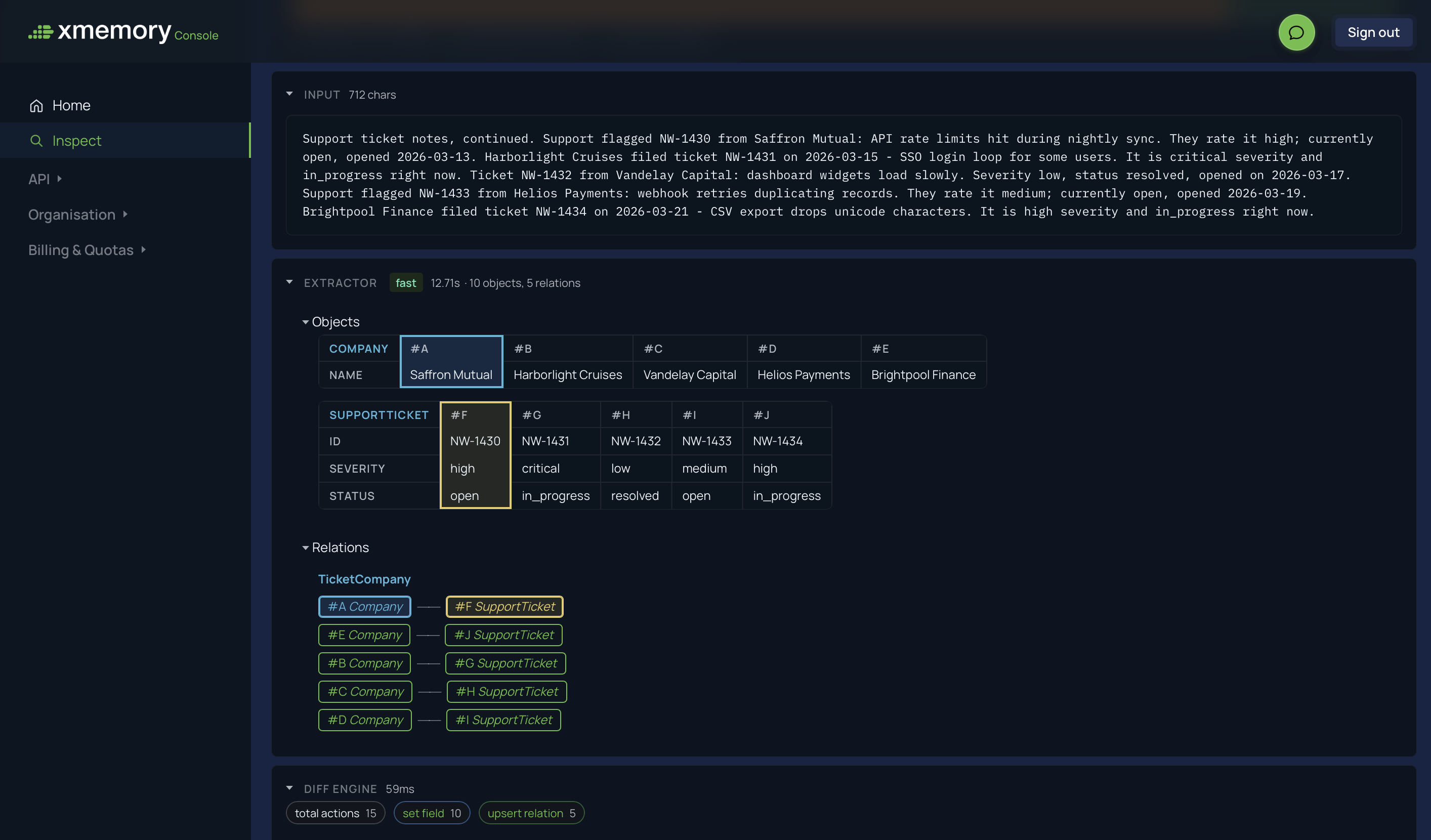
Data extraction & Schema mapping
Turn natural-language writes into facts that match your memory model.
02
Validation & Type enforcement
Keep stored memory aligned with expected fields, types, and constraints.
03
Deduplication & Stateful updates
Update the current state instead of accumulating conflicting notes.
04
Relations & Queryable state
Store facts as connected state that can answer direct product questions.
05
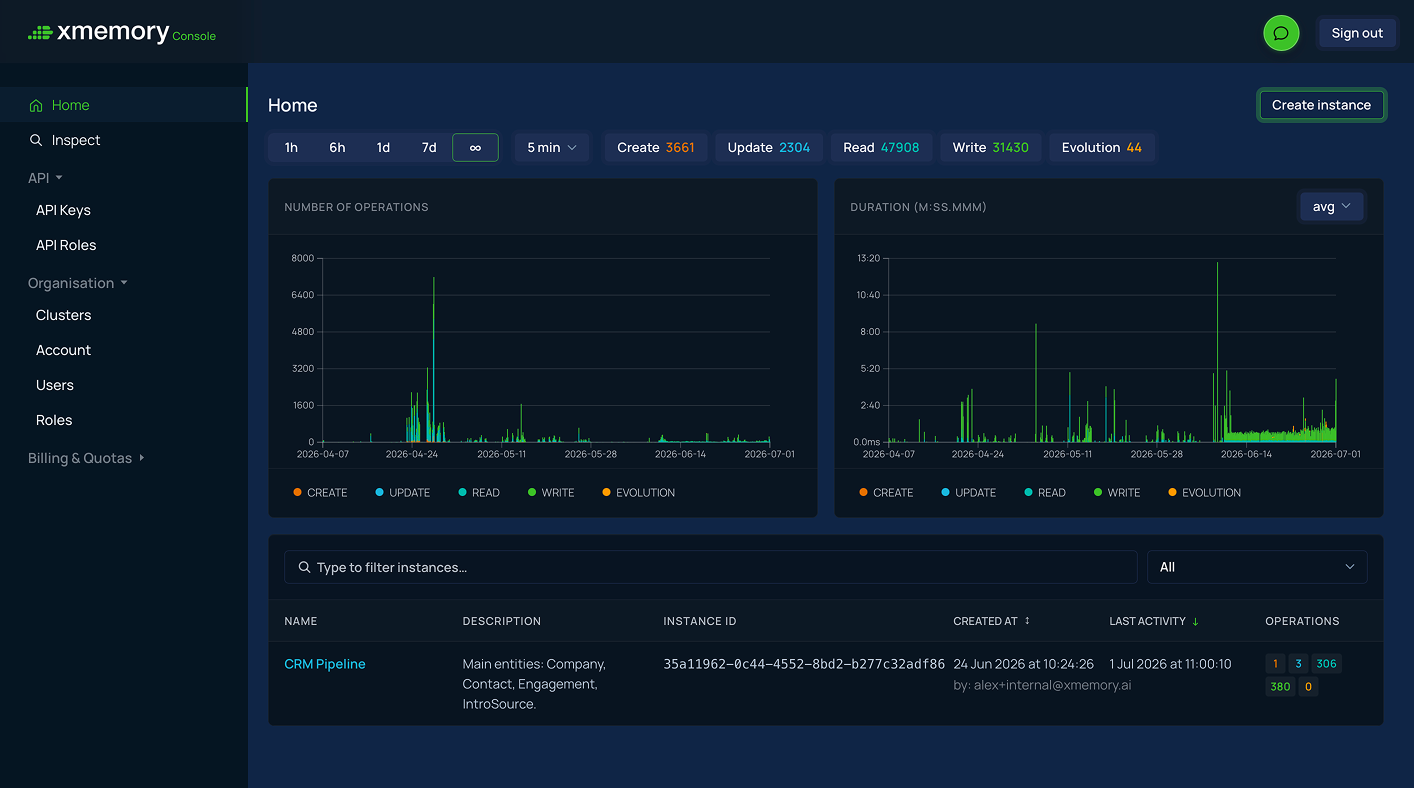
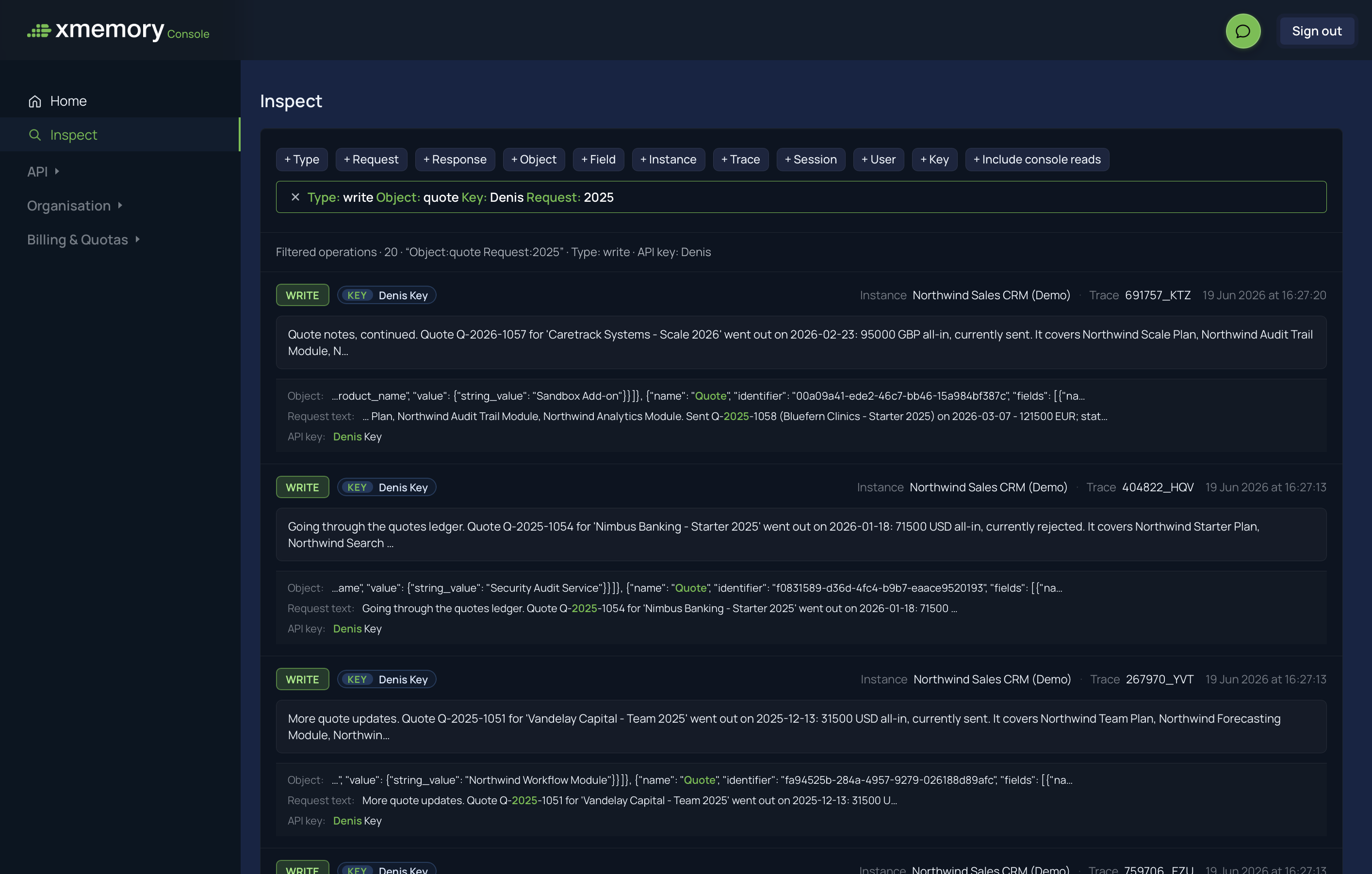
Provenance & Observability
See where memory came from and how reads and writes changed it.
06
Governance
Control access, review sensitive memory, and keep humans in the loop.
07
Schema creation & Evolution
Author or generate schemas, test changes, and review migrations as your workflow evolves.
08
Async write queue
Let agents keep moving while memory writes are processed reliably.
Agent-native connectivity and integrations
Connect xmemory where your agents already work: through MCP tools, CLI flows, direct APIs, language SDKs, or pre-built integrations for common agent frameworks and automation stacks.