Operations explorer
Query every memory operation
Filter reads and writes by type, object, or value. Trace each operation back to its session, trace, and source to debug agent memory as data, not prompts.
Let agents read and write in natural language while xmemory turns facts, relationships, and workflow state into validated, queryable memory.
By sending a message, you agree to our T&C.
Agents speak naturally. xmemory keeps the state structured.
Stores notes, summaries, and recalled context.
Converts natural-language memory writes into typed, validated, queryable state.
User likes red flowers.
Amy is now Kevin’s boss.
Vacation from March 11 to 15.
Preference: flower_color = red
Relationship: Amy manages Kevin
Plan: vacation_start = March 11, vacation_end = March 15
Inspect every read and write, trace memory lineage, and control access to structured memory state.
Operations explorer
Filter reads and writes by type, object, or value. Trace each operation back to its session, trace, and source to debug agent memory as data, not prompts.
Operations inspector
Inspect extracted objects, relations, and diff plans to understand exactly what knowledge was added, updated, or removed.
Trace memory back to source text, session ID, and trace ID.
Send structured memory events into your telemetry stack.
Apply table-level, column-level, and field-level controls.
Structure improves memory quality.
xmemory extracts structured data better than one-shot structured output.
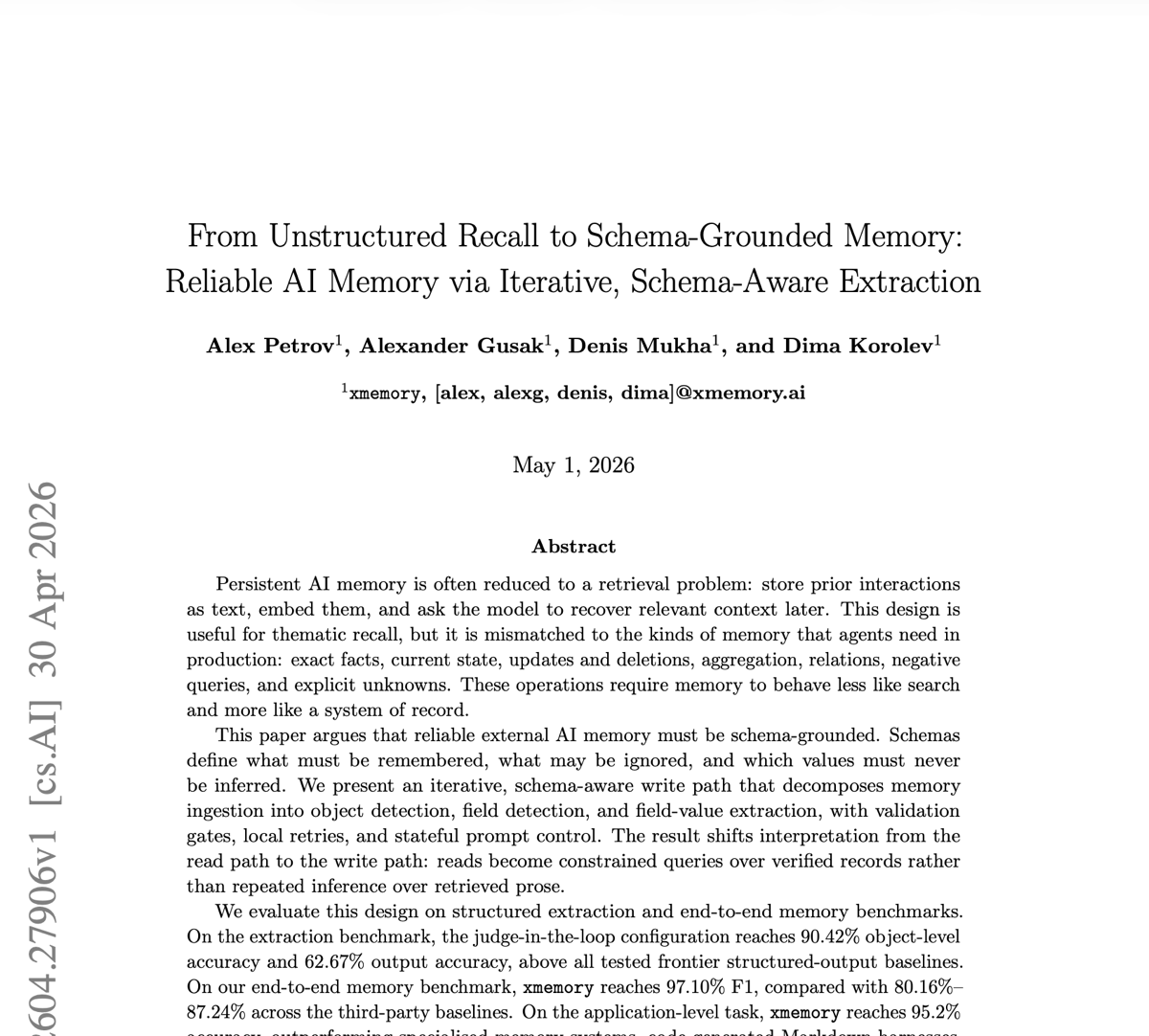
We evaluate whether systems can store, update, deduplicate, and retrieve facts and relationships reliably, not just whether they can recall similar text.*
Main markers show extraction quality for single-object schemas. Range spans complex relational schemas to single-field F1 — and xmemory stays ahead of one-shot frontier model APIs.*
* Read more about measurement methodology and open benchmarks in our white paper.
Lower token use than text-based memory by optimising reads.
3x+ fewer tokens
Assuming 10 reads per write,
10 write tokens per read token for xmemory,
and 3 write tokens per 6 read tokens for typical text-based storage architecture.
Built for teams shipping agents that need durable state.

Give long-running agents a shared state layer for plans, task progress, tool knowledge, intermediate facts, and handoffs.

Store user preferences, profile facts, and workflow context once, then query them reliably across chats, agents, and applications.
Dear , please read the integration documentation and integrate xmemory into my project.
I want to use xmemory whenever they need to store information related to their context, execution steps, or tool usage. They should create memory schemas dynamically when needed for a task, or use schemas that I will explicitly define.
Start fast in our cloud, keep data in your database, or run the full stack under your control.
xmemory runs fully in our cloud. Best for POCs, independent developers, and teams that want quick adoption with high reliability and low support effort.
Connect your RDS, Azure, or GCP database. xmemory processes requests in our cloud, while your stored data remains inside your controlled database environment.
Run xmemory from our Docker Compose package in your own environment, using your own LLM keys and enterprise contract terms.
As business logic moves into prompts, the boundary between agent reasoning and system-owned semantics needs to become much cleaner.
The core idea behind xmemory and why text-only memory misses many complex memory request types.
xmemory is not just a database exposed through MCP. It is a schema-based memory layer that lets agents read and write in natural language while xmemory owns the state-of-the-art harness that is otherwise fragile and spread across prompts, wrappers, and workflow code:
MCP can expose tools. xmemory is meant to make the memory behavior itself agent-native and reliable. For the deeper architectural argument, see Should Agents Adapt to Systems - or Should Systems Adapt to Agents? .
You do not need to hand-design a schema first. You can start from an existing system, describe the memory you need in plain language, or let xmemory generate a schema for the workflow. The goal is to make structured memory available even when you know what should be remembered but do not want to model everything from scratch. See How xmemory works for the full flow.
Text and vector memory are useful for recall. xmemory is built for reliable state. If memory is stored mainly as text, every read becomes another act of interpretation. xmemory’s approach is to keep memory structured underneath, so facts can be updated explicitly, relationships stay clear, and answers do not depend on reconstructing meaning from narrative history every time. For the fuller argument, read Schema as the Core of Reliability in AI Memory .
Yes. xmemory is designed to fit into existing stacks. You can bring structure from an existing system of record, then integrate through MCP, API, Python, or TypeScript depending on how your agents and workflows already run. The docs also include examples for frameworks like LangChain, Pydantic AI, Mastra, Google ADK, and n8n. You can jump straight to the integration guides in How xmemory works .
Tell us about your workflow and we’ll help you choose the right integration path.
© 2026 xmemory Inc. All rights reserved.